

Not another email agency.
A senior operator inside your business for 90 days.
I spent three years owning email revenue inside an eight-figure Shopify brand. Now I build the same retention systems for a small number of brands doing $1M–$10M, then help keep them performing.
I have done this job.
Not advised on it.
Most agencies learn your business from a kickoff deck. I learned mine from three years of owning the number. Email and SMS at an eight-figure DTC pet wellness brand, across the US, Canada, and the UK. I built the flows, ran the campaigns, fought the deliverability fires, and migrated a million contacts to Klaviyo without losing a day of revenue.
I do not manage twenty brands. I take a handful at a time, because operating inside a business and checking in on it once a month are not the same job, and only one of them makes money.
The problems I solved at one eight-figure brand are the same problems most growing brands have. The difference is they cannot justify a senior email hire at $120K a year to solve them. The Sprint is how a brand gets that level of execution without the permanent headcount, and it is why I would rather do this for a handful of companies than go back to doing it for one.
Turn email into a predictable revenue channel.
90 days. One system. Built, tested, documented, and yours to keep.
Audit everything, assume nothing
Full audit of your platform, deliverability, list health, and every flow you have, whichever ESP you are on. I map your product reorder cycles against what is actually built. You get a written diagnosis, ranked by what each problem is costing you per month, before I build anything.
Build the flows that actually sell
Six to eight automations engineered to your purchase cycle, not Klaviyo's defaults. Welcome, cart, browse, post-purchase, replenishment, win-back, sunset. Segmented by buyer behaviour, not guesswork.
Make campaigns a habit, not a scramble
Branded templates your team can actually use. A 90-day campaign calendar. Then a live optimization window where I test subject lines, timing, and offers against real sends.
Prove it, then keep it running
Before and after numbers on every flow and campaign. Full documentation. You own all of it. Then we decide together what month four looks like.
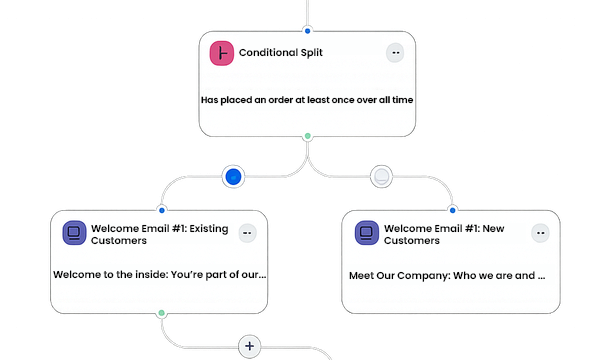
A live flow from a Sprint build. This is the level of architecture, not a template swap.
Here is exactly what the first 30 days look like.
No mystery. No black box.
The scariest part of hiring anyone is not the invoice. It is not knowing what happens after you send it. So here is the calendar, week by week, before you spend a dollar.
Access, audit, and a hard look at the numbers
- 90-minute kickoff call. Your products, margins, reorder cycles, and customer objections.
- Klaviyo, Omnisend, Brevo, or whichever ESP you run, plus Shopify and domain access. SPF, DKIM, and DMARC checked and fixed the same week.
- Full audit of every existing flow, form, and segment. Nothing is assumed to be working.
The revenue leak report and the target
- Written audit delivered: every leak, ranked by what it is costing you per month.
- We agree on the 90-day revenue target together, modelled on your traffic, list, and AOV.
- We agree on what you own: send cadence, promo calendar, and approval turnaround.
The first flows go live
- Welcome series built and shipped, split by buyer and non-buyer.
- Abandoned cart and browse abandonment rebuilt around your actual products.
- Weekly 30-minute check-in starts. Same day, same time, every week from here.
Replenishment, and the first revenue you can see
- Replenishment flow built to each product's real consumption cycle. This is usually the single biggest win.
- Post-purchase education sequence live.
- First performance review against baseline. You see numbers in month one, not month three.
Why this is not what you have tried before.
What this looks like when it is done properly.
Eight-figure DTC pet wellness brand
"The replenishment flow alone generated $88K in a single year. One automation, calibrated to how fast each product actually gets used up, running around the clock with nobody touching it. That is what a retention system looks like when it is built for the product instead of pulled off a shelf."
Mark Robinson, ecompromoter
We agree on success before I start.
If we miss it, I keep working.
Before a single email is built, we model a realistic revenue target from your traffic, customer base, and average order value. Not an inflated number designed to win the sale. A number we both believe.
If we are both executing the agreed plan and that target is not hit within 90 days of your flows going live, I keep optimizing at no additional cost for up to 60 more days until it is.
Your automations keep earning on their own.
Your campaigns do not.
At the end of 90 days you own a retention system most brands never build internally. Every flow, template, segment, and document is yours. The automations run whether I am here or not.
Campaigns are different. Email is not a website you launch once. It is an operating system that only compounds if someone is testing offers, watching segments, protecting deliverability, and shipping every week. That someone has to be a person, and it has to be every month.
If ongoing operation makes sense, I continue running the system month to month. That is ongoing retention management: campaigns, testing, optimization, and reporting, month after month.
If you have an internal team ready to take it, I will train them and hand over everything. That is a successful outcome too. But you should decide that after you have seen the numbers, not before.
I am not right for everyone.
This works if
- You are an ecommerce DTC brand doing $1M to $10M
- You are on Klaviyo, Omnisend, Brevo, Spoks, or ready to move
- Your products get consumed, replaced, or reordered
- Email is under 20% of revenue and you know it should be higher
- You can commit to a send cadence and approve work inside a week
This does not work if
- You are under $500K. The math does not carry the fee yet.
- You want SMS, ads, and social from one vendor
- You want someone to send more email, not build a system
- You need the cheapest option on the table
- Nobody on your side can make a decision in under a month
Common questions
Your email is underperforming.
Let's find out by how much.
A 20-minute call. Bring your current email revenue, list size, and biggest frustration. I will tell you honestly whether a Sprint makes sense, and if it does not, I will tell you that too.
BOOK A 20-MINUTE CALL